
Facebook Parental Supervision · 2023–2024 Designing supervision teens actually say yes to
A parent wants to keep their teen safe online. A teen wants to be trusted. These two needs pull in opposite directions — and both are valid.
With over 10 million active teens on Facebook and 700K new teen sign-ups daily, the pressure was real. Research showed 21% of guardians blocked Facebook entirely for their teens — not because the platform was inherently unsafe, but because they lacked any visibility into their teens experience. Meanwhile, 65% said they would allow access if they had supervision tools.
The question was not whether to build supervision. It was: how do you design oversight that teens actually accept?
My role
I established the design principles that shaped the product, navigated the tension between parental control and teen autonomy, and iterated through multiple rounds of concept testing that directly informed what shipped — and what we deliberately chose not to build.
Beginning in May 2024, this work evolved into Family Center, Metas unified supervision hub across Facebook, Instagram, Messenger, and Meta Quest.
As Design Lead on Facebooks Integrity and Privacy team, I drove the creation and strategy for Parental Supervision from its earliest concepts through MVP launch. I organized and led a week-long cross-functional design sprint in Seattle (Mar 2023) with designers, product managers, and researchers from Privacy, Integrity, and the cross-Meta Family Center team.
Where teens actually spend their time
Before we could design supervision, we needed to understand how teens actually use Facebook. The data painted a clear picture. Newsfeed, Videos, and Messenger collectively take a lions share of teen time. This meant supervision tools needed to address the full breadth of how teens engage — not just one surface.
Teen Audience — Surface Breakdown
Newsfeed
91.96%
of teen users visit Newsfeed, accounting for 18.89% of all time spent
Videos
54.19%
visit Videos, which takes the largest share of time at 27.88%
Messenger
61.69%
visit Messenger, accounting for 18.71% of time spent
Two families
During the sprint, we worked with four research-based personas that grounded every design decision in real human stories. Two stood out as defining for the project:
Jay — Family Troubles
Jay is 13, lives in an unstable housing situation, and loves gaming videos. He gets drawn into Facebooks recommendation algorithm — borderline content leads to more borderline content. He joins a pile-on in the comments, bullying another user. His school finds out. His parents find out.
With no supervision tools to set boundaries earlier, Jays parents resort to banning Facebook entirely. But Jay sneaks back on using a public computer. His behavior escalates. The ban has created a relationship around technology built on distrust rather than conversation — exactly the opposite of what the family needed.
These stories crystallized the core insight: without proper supervision tools, families default to extremes — either zero visibility or total intrusion. Both fail. Connors parents see everything and violate his privacy. Jays parents see nothing and lose the ability to guide him. We needed to design the middle ground.
Connor — Exploring Identity
Connor is a gay teen exploring identity and self-expression online. Hes popular and outgoing with friends, but guarded at home — he hasnt come out to his parents. He joins LGBTQ+ groups on Facebook to find community and connect with people whove been in his exact situation.
When his parents notice his increased Facebook usage, they grow concerned. Without any supervision tools, they resort to the only option available: forcing Connor to show them his feed. This reveals his identity — something he wanted to share on his own terms. The result is a rift between Connor and his parents. Connor loses both his privacy and his community.
A system built on consent
Supervision is a two-sided, opt-in system. A parent invites their teen. The teen must accept. Either party can end supervision at any time.
This consent model was a deliberate choice — a tool teens reject protects no one. Once connected, parents gain access to insights and configurable controls through Family Center. Teens see full transparency into what their parents can view and do.
Four design challenges at the heart of teen supervision
02 Provide opportunities for safe exploration
Social media helps teens explore their identities during a transitional phase, allowing them to express themselves in less vulnerable ways — through multiple accounts, disappearing content, or avatars. Guardians seek non-invasive tools for safe exploration, but overly intrusive methods lead to rejection. The challenge is balancing supervision with respect for teens' privacy and autonomy.
01 Adapt to teens as they grow
Teens represent a diverse user group with varying privacy needs based on age and maturity, which evolve as they grow. As teens mature, parents' roles shift from setting strict limits to fostering trust and open communication. Designing for these changing dynamics is key to creating supervision tools that add value for both teens and guardians over time.
04 Enhance parent-teen communication
Conversations about social media often become adversarial. Teens feel distrusted when oversight is too high, leading to tension and reluctance to share. While guardians are mindful of privacy, they feel that objective third-party insights from apps can help de-escalate these discussions and open healthier dialogue between families.
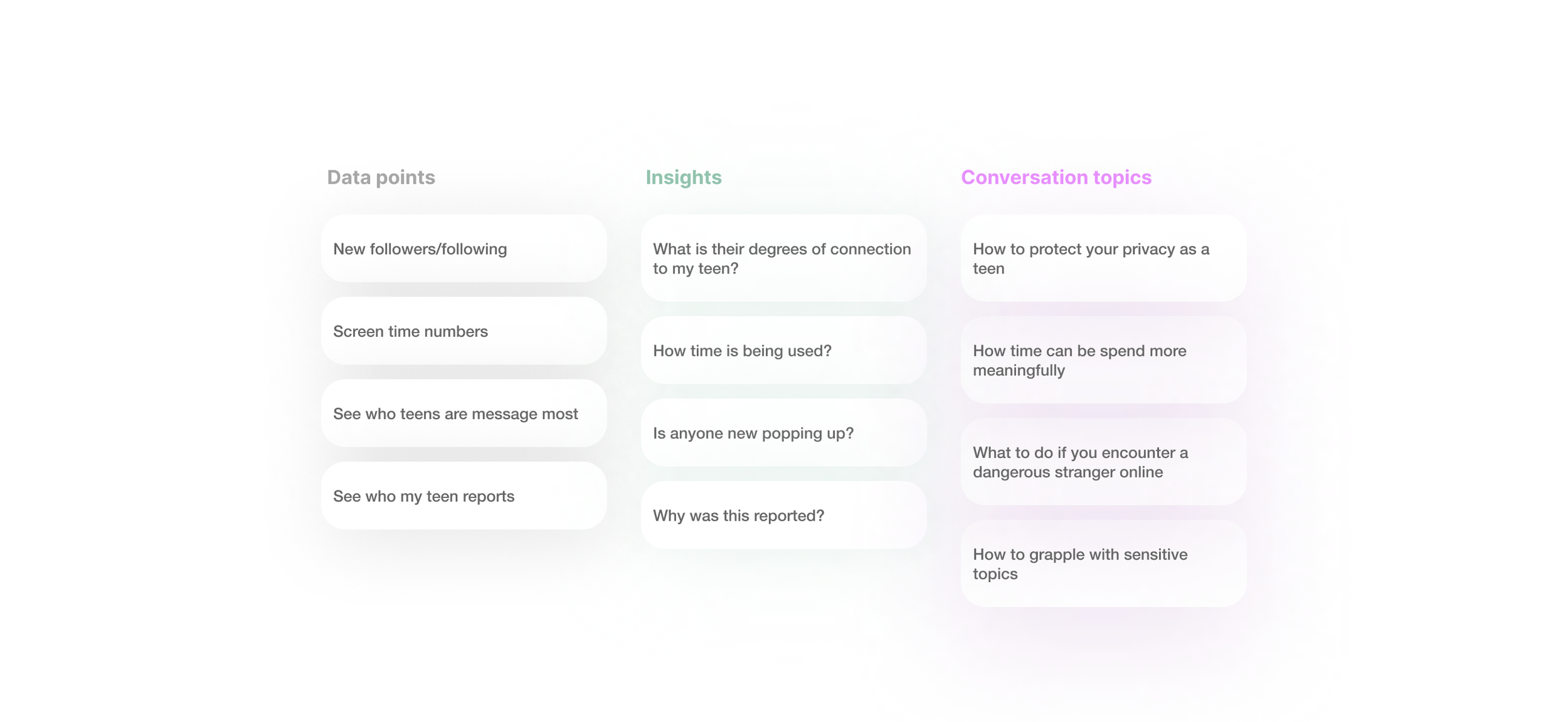
03 Support guardians and demystify social media
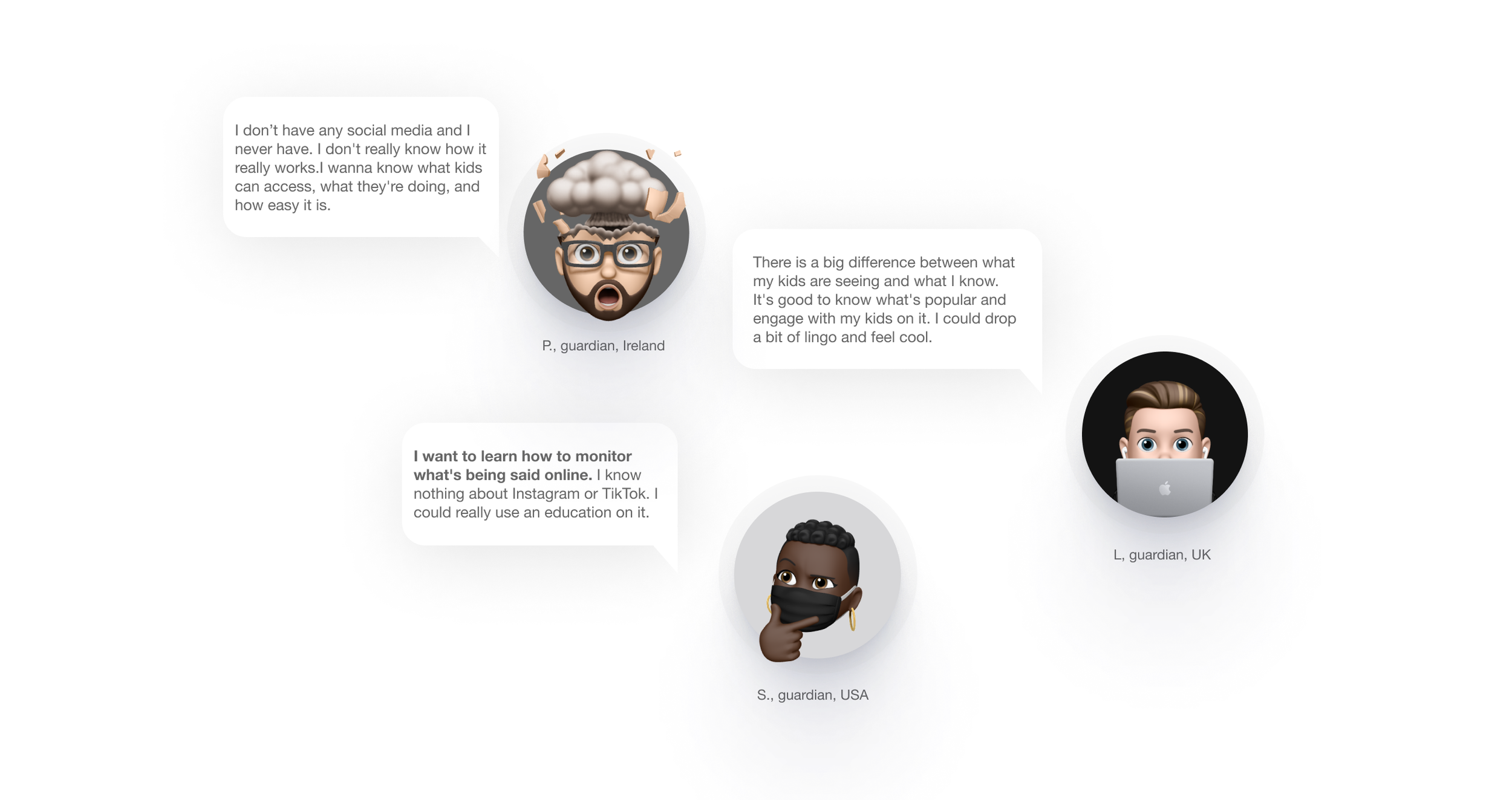
Less than half of guardians feel comfortable navigating basic tech tasks. Even those with technical knowledge struggle to grasp the nuances of their teens' social media experiences. Teens, in turn, wish their guardians better understood their concerns, often feeling hesitant to discuss social tech because they believe their guardians "won't understand."
Sprint Concepts
I led a series of design sprints to develop the post-MVP feature roadmap. Each concept was framed around a specific user problem, explored through multiple design directions, and tested with parents and teens.
The parent experience centered on Family Center — one place for parents to gather the right level of detail about their teens activity. The key insight from testing: providing the right level of detail is everything. Too little and its useless. Too much and its overwhelming — or invasive. The intention is to promote conversation and find solutions as a family.
For teens, the experience needed to be contextual and in-the-moment — not a destination they’d never visit, but guidance that appears right where they're already engaging.
Time Spent / P0
Problem: General screen time numbers alone aren’t useful. A parent sees 3 hours but doest know if thats 3 hours of messaging friends or 3 hours of doomscrolling. Without context, time limits become arbitrary — like Jays parents resorting to an outright ban.
Solution: A detailed screen time breakdown showing where and when teens spend time — which features they use most, peak usage windows, and day vs. night patterns. This gives parents the context to have informed conversations rather than impose blanket restrictions.
Connections / P0
Problem: Parents want to understand the social landscape their teen is building — not to spy, but to have a sense of who their teen is interacting with. The research pain point was stark: families had either zero visibility or could see the entire feed. No middle ground existed.
Solution: A Connections section showing Friends, Groups, Pages, and Events a teen engages with. This gives parents visibility into the shape of their teens social world without exposing private conversations.
Security Settings Visibility / P0
Problem: Many teens are new to managing their own accounts and may not know security basics — strong passwords, two-factor auth, recognizing suspicious logins. Farhans persona story illustrated this: he didnt realize his phone number was public until a stranger called him.
Solution: A security overview surfacing password strength, 2FA status, and alerts for unrecognized device sign-ins. This turns abstract security into something actionable for both parents and teens.
Privacy Settings Visibility/ P0
Problem: Some connections: Groups joined, Pages followed — are identity signals a teen may want to keep private. Connors story made this visceral: a teen exploring their identity through a support group shouldnt have that surfaced to their parent without consent.
Solution: During teen onboarding, teens select which connection types to share with parents. Friends are shared by default; other categories are opt-in. This gives teens meaningful control over what supervision reveals about them.
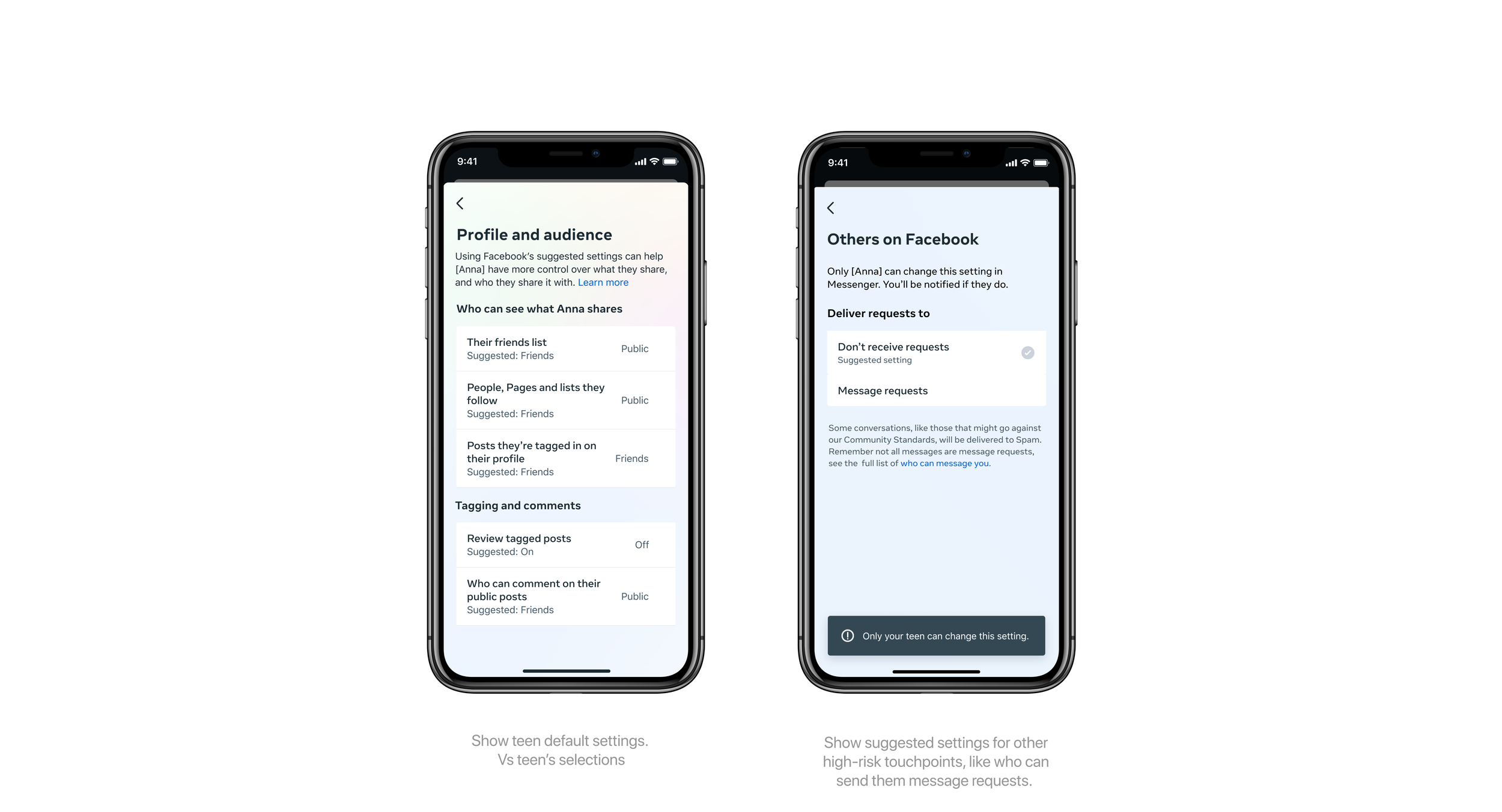
Settings recommendations / P0
Problem: Meta's default privacy settings for teens are actually quite protective — but most parents don't know this. Parents also want to see what settings their teen has chosen.
Opportunity area: Raise awareness of our suggested settings to parents and highlight opportunities for teens to use safer settings.
Solution: A settings overview in Family Center showing Metas recommended setting alongside the teens actual selection. This educates parents about whats already in place and highlights where the teen may have chosen a less protective option.
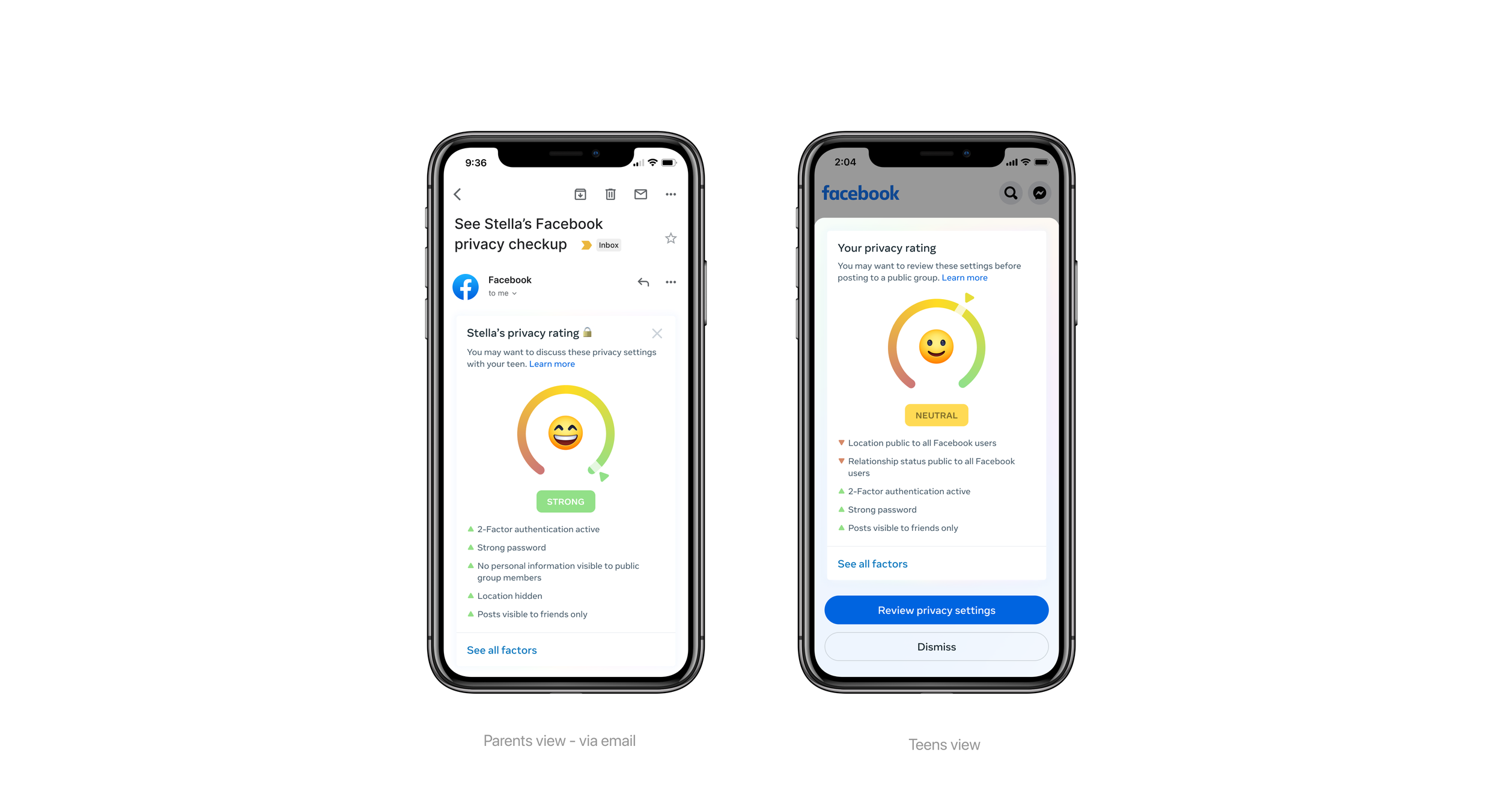
Privacy Rating / P1
Problem: Privacy settings feel overwhelming — dozens of toggles with no sense of what good looks like. Bellas persona story showed this: she was the rare tech-savvy teen, but most of her friends had no idea what their settings even did.
Solution: An explicit privacy rating that benchmarks settings, flags oversharing, and nudges families to review at key moments — like when a teen first joins a Group or creates their first public post.
Teen’s posts Insights / P1
Problem: Teens don’t always understand who can see their posts or how privacy settings affect content visibility. This can lead to unintended exposure.
Solution: This helps teens self-correct before problems arise, while giving parents transparency on the other side.
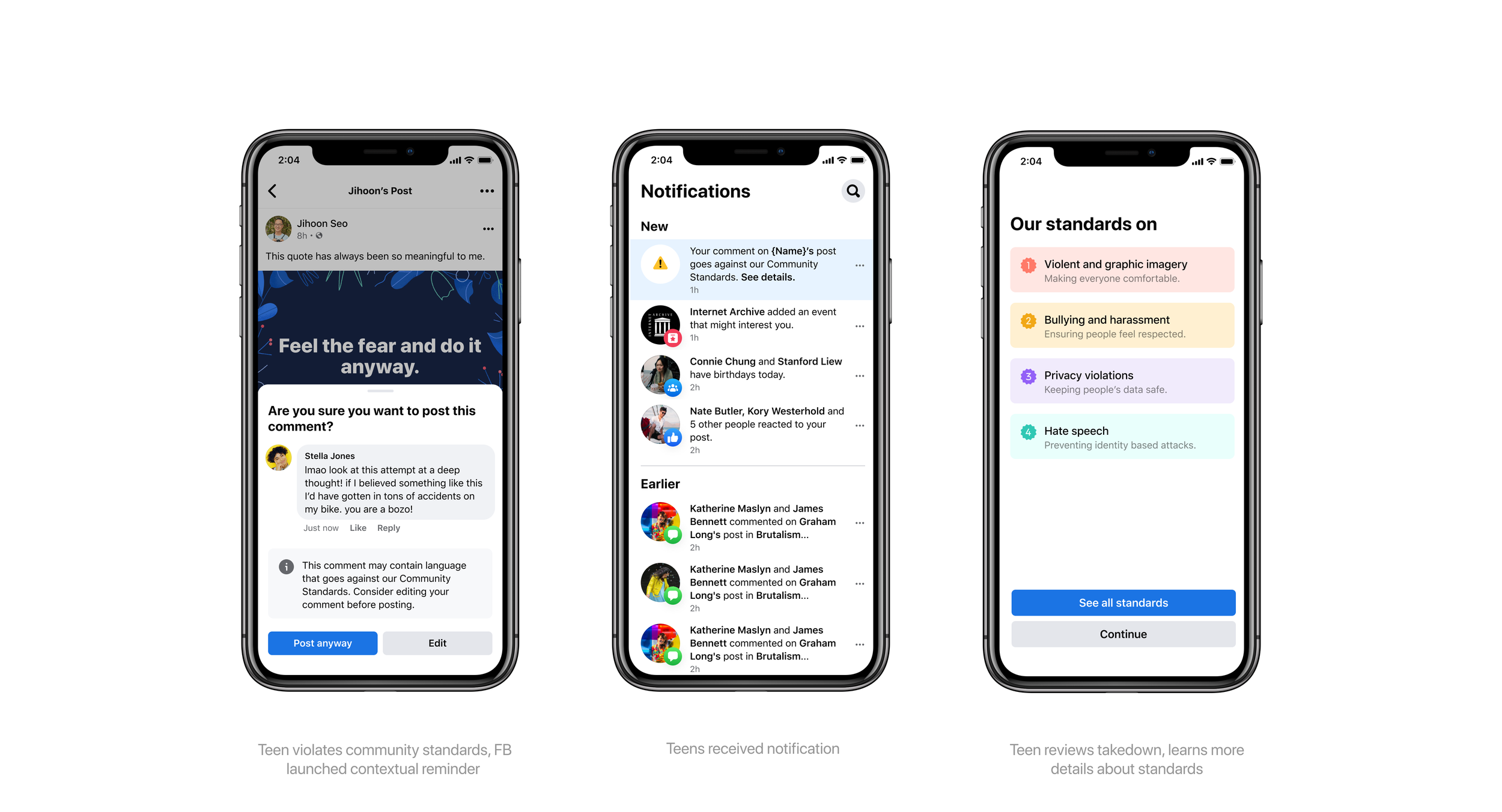
Trigger Community Standards Education / P2
Problem: Jay’s journey made this clear , he didn't understand why his comments were removed because hed never encountered the community standards before violating them. They're thorough but buried.
Solution: Contextual education that surfaces community standards inside the product, at the moment they're relevant. When a teens content is removed, they see a clear explanation and learn about the standard, prompting reflection and giving families a shared reference point for discussing online behavior
Content Recommendation Reset / P2
Problem: Often people are intentionally or unintentionally drawn into rabbit holes or patterns of recommendations that can be harmful over time
Solution: Give visibility into when this behavior might be forming, and provide corrective measures in the form of, Nudges, ‘New to you’ type content diversification and Resources for content evaluation
MVP Overview
Parents Experience: Focus on Family Center
The Family Center is the central area of the parent's side supervision experience. We are providing one place for parents able to gather enough data about their teens. Providing the right level of detail is the key. The intention is to promote conversation and find a solution as a family.
Teens Experience: Contextual & in the moment
For teenagers, Facebook supervision occurs frequently and in a more interesting setting when it is contextual.
The hardest part wasn't the features
The work that started as a week-long design sprint in Seattle became Facebook Parental Supervision, which became the foundation for Family Center — Metas cross-app supervision experience now serving families across Facebook, Instagram, Messenger, and Quest.
This project taught me that designing for families means designing for a relationship — with all its complexity, power dynamics, and evolving trust.
The hardest decisions weren't about features. They were about restraint: what not to show parents, when not to add a control, where to trust teens to self-regulate. Connors story was our constant reminder — the cost of getting this wrong isn't just a bad UX metric. Its a teen losing their community and their trust in the people closest to them.